
.avif)

Blog Summary
- Why hiring more staff is not the only answer when your practice is at capacity
- What outsourcing for accounting firms actually looks like in a UK practice setting
- The specific tasks you can hand off without losing visibility or control
- How Finqube's dedicated remote team model, backed by proprietary AI review software, gets firms scaling within weeks, not months
Why Capacity Problems Keep Coming Back
Your team is stretched. Deadlines are stacking. You have turned down two new clients this quarter because you simply do not have the hours. So you start a recruitment process, spend three months interviewing, onboard someone new, and six months later you are back in the same position.
Hiring solves a headcount problem. It does not solve a capacity model problem.
Most UK accounting practices reach a ceiling not because they lack talent, but because their entire capacity sits in permanent, fixed headcount. Every peak period, every client acquisition, every deadline cluster runs through the same bottleneck.
Outsourcing for accounting firms changes that equation. It gives you a variable capacity layer that scales with your workload, without the recruitment timeline, the employment costs, or the risk of a permanent hire who does not work out.
What Is Outsourcing for Accounting Firms?
Outsourcing for accounting firms means bringing in qualified accounting support that works inside your existing systems, follows your existing processes, and is accountable to your review, without being on your permanent payroll.
It is not a call centre. It is not someone processing data in isolation and sending back a spreadsheet. Done properly, an outsourced accounting team member works inside your Xero, QuickBooks, Sage, or FreeAgent environment the same way an in-house hire would, with the difference that they are available when you need them and not costing you when you do not.
The tasks most commonly outsourced by UK practices include:
- Bookkeeping and bank reconciliation
- Accounts finalisation and preparation
- VAT return preparation and MTD compliance
- Month-end close support
- Payroll processing and auto enrolment
- Management accounts preparation
- Accounts payable and receivable management
The critical distinction is accountability. A well-structured outsourcing arrangement is not a black box. You should be able to see what is being worked on, when, and to what standard, without chasing anyone for an update.
Why Do Accounting Firms Outsource?
The primary reason is capacity, not cost.
Practice owners who outsource are not usually trying to save money first. They are trying to stop turning away clients, stop working weekends, and stop being the last line of review for every file because there is no one else they trust to check it.
According to ICAEW research on practice management, the most cited pressures on UK practice owners are staff retention, workload peaks, and the cost of permanent headcount relative to fluctuating client demand. These are structural problems that an additional permanent hire does not fully resolve.
Outsourcing gives you a second reason to consider it: speed. Hiring takes three to four months from job posting to a productive team member. An outsourced extended team member can be embedded in your workflow within one to two weeks.
The third reason is risk reduction. A permanent hire is a long-term financial commitment. An outsourced arrangement can be structured as a monthly engagement, so if the relationship does not work, you are not locked in.
Who Actually Does the Work When You Outsource?
This is the question that separates good outsourcing arrangements from bad ones.
In a poorly structured outsourcing model, the work passes through a central allocation pool. You brief a team, a task gets assigned to whoever is available, and you have no consistent relationship with the person handling your client files.
In a dedicated model, one specific accountant is assigned to your practice. They learn your clients, your review preferences, and your formatting standards. They become part of your team in every meaningful sense, except they sit outside your payroll.
For UK accounting practices, the dedicated model is the only one worth considering. Your clients expect consistency. Partners expect work to meet a specific standard. That is only possible when the same person handles the same clients repeatedly, not when files rotate through a pool.
When Is the Right Time to Outsource?
Most practice owners wait too long. By the time they explore outsourcing, they have already lost a client, declined new work, or burned out a senior team member.
The right time to act is when any of these conditions appear:
- You are consistently working more than two Saturdays per month to keep up with deadlines
- You have declined a new client enquiry in the past 90 days due to capacity
- A key member of your team is handling work below their qualification level because no one else can do it
- Partner review time is being eaten by first-pass errors that should have been caught before the file reached you
- You are three or more weeks behind on month-end close for more than one client
Any one of these is a signal. Two or more and you are already running a reactive practice, not a growing one.
Where Do the Gains Actually Come From?
The most immediate gain is time at partner level.
When a dedicated remote accountant handles bookkeeping, accounts prep, or month-end close for your clients, the files that reach your review desk are already at a much higher standard. You spend less time catching errors and more time on client relationships and advisory work.
According to AccountingWeb's UK practice benchmarks, partners in practices without structured outsourcing or delegation spend an average of 30 to 40 percent of their billable hours on work that could be handled by a qualified junior or intermediate-level accountant. That is not a staffing problem. It is a structure problem.
The second area of gain is throughput. With an additional accountant embedded in your workflow, you can take on more clients without changing your permanent cost base. The outsourced capacity scales up when you need it and scales back during quieter periods.
The third gain, less talked about but significant, is the quality floor. When every file passes through a structured review process before it reaches the partner, the number of errors reaching clients drops sharply. That protects your reputation and reduces the time spent on amendments and apologies.
How to Outsource Accounting Work Without Losing Control
This is the concern that stops most practice owners from acting. They have tried a remote provider before. The work came back at the wrong standard. They spent more time fixing errors than they saved.
The answer is not to avoid outsourcing. The answer is to choose a model that gives you visibility.
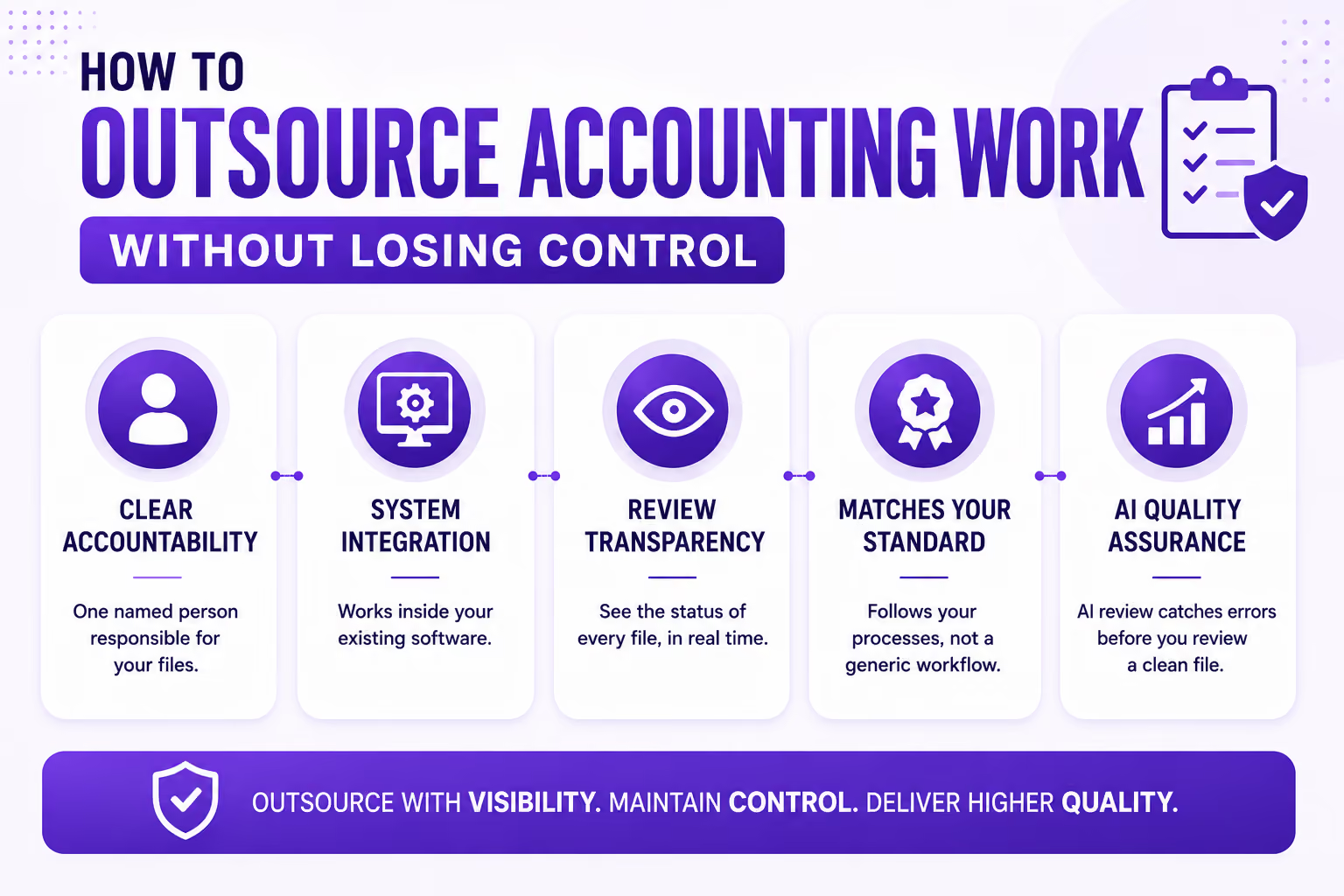
A credible outsourcing arrangement for a UK accounting practice should give you:
Clear accountability. One named person responsible for your files. Not a pool. Not a ticket system.
System integration. The accountant works inside your existing software. No parallel systems, no data re-entry, no format translation.
Review transparency. You should be able to see the status of every file your outsourced team member is working on, without having to ask. If you have to request an update, the visibility layer is broken.
A standard that matches your practice. The outsourced accountant follows your processes, not a generic workflow designed for a different practice type.
Every Finqube engagement includes our proprietary AI review software, which gives you a live view of every file your dedicated accountant is working on. Before a file reaches your review, the software has already flagged reconciliation mismatches, outstanding AP items, and common preparation errors. You review what is already clean.
Outsourcing vs Hiring In-House: A Direct Comparison
Real Scenario: How a Mid-Size Practice Recovered Capacity Without a Single New Hire
Rachel Patel runs a seven-person practice in the East Midlands. Her firm handles a mixed client base of limited companies, sole traders, and a handful of property portfolios. Three months before the January self assessment deadline, her practice would hit a wall. Two senior members of the team spent the final six weeks of the year doing work they were overqualified for, simply because there was no one else to do it.
She had looked at hiring. The combination of salary expectations, NI contributions, and pension auto enrolment made a full-time hire expensive for what she actually needed, which was an extra pair of reliable hands from October through February.
She started a Finqube pilot with one dedicated accountant embedded into her Xero environment. Within the first three weeks, her senior team members were back to review-level work. The backlog of accounts preparation cleared in the first month. By January, Rachel was reviewing clean files rather than catching first-pass errors.
By month two, she had recovered 10 hours per week of senior team time and taken on three new limited company clients. The outsourced accountant had become a permanent fixture in the practice, handling all accounts preparation while the senior team focused on client advisory and review.
The pilot cost her nothing to start. She decided to continue before the month was out.
How Finqube Can Help
Finqube provides dedicated remote accounting team members for UK accounting practices. Every engagement includes:
- A qualified accountant assigned exclusively to your practice
- Our proprietary AI review software, which gives you a live view of every file and flags issues before they reach your review desk
- Deployment within 1 to 2 weeks of starting
- A one-month free pilot with no contract
The model is built for practice owners who need capacity, not a vendor relationship. Your Finqube accountant works inside your systems, follows your processes, and is accountable to your review, every time.
You can calculate the impact on your practice using our ROI Calculator or explore our FTE model for practices that want dedicated full-time support.
Start with the one-month free pilot. No contract. No commitment. See how it works before you decide.
Conclusion
Scaling your accounting practice does not require a permanent hire every time workload increases. It requires a capacity model that matches your actual demand pattern.
Outsourcing for accounting firms, done properly, gives you a qualified accountant working inside your systems, accountable to your review, with full visibility into every file. The gains are felt immediately at partner level: less time catching errors, more time on advisory, more capacity to take on new clients.
If your practice is turning down work or burning out senior team members to meet deadlines, that is not a staffing problem. That is a structure problem. And it has a solution that does not require three months of recruitment.
Start your one-month free pilot with Finqube.
FAQ
What is outsourcing for accounting firms?
Outsourcing for accounting firms means engaging a qualified accountant who works inside your existing systems and follows your processes, without being on your permanent payroll. The work is done to your standard and is accountable to your review, giving you the capacity of an additional team member without a permanent employment commitment.
How quickly can an outsourced accountant be up and running?
With a dedicated model, a qualified accountant can be embedded in your workflow within one to two weeks. This compares to three to four months for a typical in-house hire from job posting to productive output.
Will I lose control of client work if I outsource? Not with the right provider. A well-structured outsourcing arrangement gives you full visibility into every file your outsourced accountant is working on. The right model means you review clean, flagged-up work rather than doing a first-pass check yourself.
What accounting software does an outsourced team work with?
A quality provider will work inside whichever software your practice already uses: Xero, QuickBooks, Sage, or FreeAgent. You should not have to change your tech stack or re-enter data between systems.
Is outsourcing for accounting firms only for large practices?
No. Practices of 2 to 20 staff benefit most. Smaller practices have fewer redundancy options when a team member is on leave or during peak periods. A dedicated outsourced accountant fills that gap without a permanent cost.
How is outsourcing different from hiring a freelance bookkeeper?
A freelance bookkeeper typically works independently, outside your systems, with limited accountability to your review process. A dedicated outsourced team member works inside your systems, follows your processes, and every piece of work passes through a structured review before it reaches you.
What tasks can I outsource to an accounting firm support provider?
The most commonly outsourced tasks include bookkeeping and bank reconciliation, VAT return preparation, accounts finalisation, month-end close support, payroll processing, management accounts preparation, and accounts payable and receivable management.